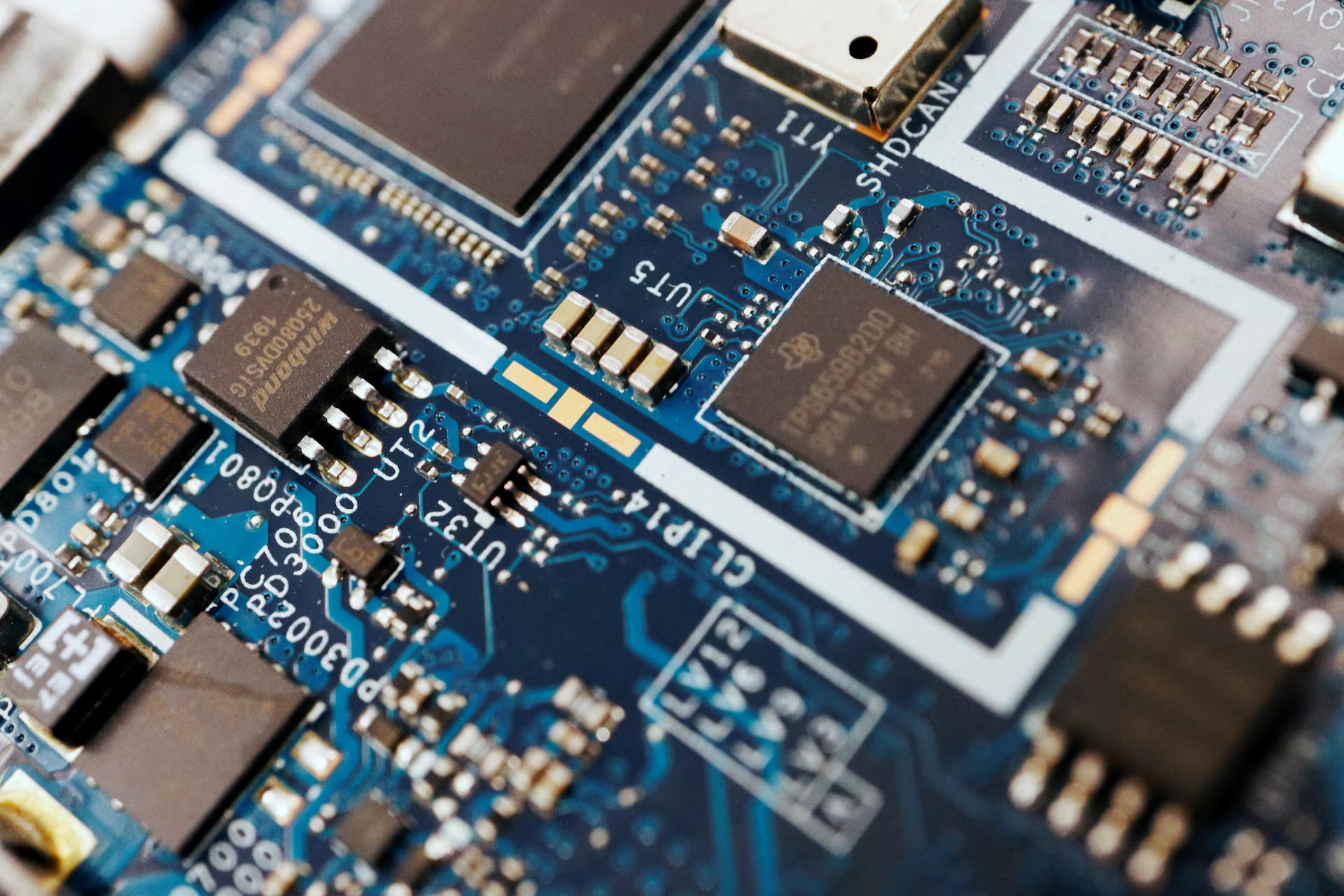
The AI trade still starts in the United States. Nvidia’s data-centre GPUs and Micron’s high-bandwidth memory sit at the core of the current build-out, and both companies have spent the past year reorganising around that demand. Nvidia continues to report demand it cannot fully supply, while Micron has reshaped its business around cloud customers and HBM orders tied to leading GPU platforms. Compute and ultra-fast memory now move together, and that pairing is driving the latest wave of global data-centre investment.
Australia is not competing at the chip-foundry level, but it is tied into this cycle one layer up. Local exposure comes through data centres, power, cooling and networks rather than silicon. ASX-listed operators are effectively selling the physical environment that Nvidia- and Micron-based systems require to run at scale. Industry research suggests national data-centre capacity could more than double from roughly 1,350 megawatts in 2024 to over 3,000 megawatts by 2030 as AI workloads expand. New campuses designed for dense, liquid-cooled racks are being marketed directly to hyperscalers and government clients.

Around that physical layer sit firms like Megaport, which provides the network fabric linking data-centres and cloud regions. Recent moves to offer compute closer to users through low-latency platforms have been positioned as plays on AI inference rather than general cloud connectivity. Coverage of these stocks increasingly focuses on operational detail: contracted utilisation, power secured, cross-connect growth, and the pace at which commitments from US cloud customers convert into recurring revenue.
There is also a smaller semiconductor angle domestically. Estimates of Australia’s semiconductor market range from roughly 3 to 14 billion dollars in the mid-2020s, depending on definition, with policy attention now on a National Semiconductor Strategy and a proposed manufacturing hub. For now, local exposure tends to sit in niche design, tooling or memory-adjacent segments rather than full-scale fabrication, limiting how closely these names track the upside captured by US chip leaders.
In index terms, the global price-setters for AI remain offshore. The more relevant question for Australian tech is how much of that momentum lands physically in domestic facilities and networks. To the extent that AI workloads are hosted, powered and interconnected locally, global chip demand stops being an abstract theme and starts to show up in Australian earnings lines.
The views expressed in this article are the author’s own and do not necessarily reflect those of this publication.
Disclaimer: This article is for informational purposes only and does not constitute financial advice. Always consult with a qualified financial advisor before making investment decisions.